
Dialysis is unlike almost any other appointment on a patient’s calendar. Most people on in-center hemodialysis go three times a week, every week, for years. Miss a session and the consequences are medical rather than administrative. That turns transportation from a convenience into part of the treatment plan.
Medical transportation for dialysis gets arranged badly more often than it gets arranged well, usually because families treat the first few weeks as something to improvise through. The patterns that cause trouble are predictable, and so are the fixes.
What the Dialysis Schedule Actually Demands
A standard in-center session runs three to four hours, and that is only the time in the chair. Add check-in, weighing, getting onto the machine, and the wind-down afterward, and a treatment morning easily runs five hours door to door.
Centers run in shifts, often starting before dawn and continuing into the evening. A patient assigned to the first shift may need a pickup at five in the morning. That slot is usually fixed, because the chair belongs to someone else an hour later.
The weekly pattern is either Monday, Wednesday, Friday or Tuesday, Thursday, Saturday. Once a patient is placed on a rotation, it rarely moves. Transportation has to match that rhythm rather than the other way around.
The Return Trip Is the Harder One
Families planning dialysis rides tend to focus on getting there. The drive home is where most of the difficulty sits.
Patients commonly leave a session tired, and some experience low blood pressure, cramping, or lightheadedness as fluid is removed. Someone who walked into the center steadily may need an arm to lean on walking out. That difference matters when choosing a service level, because a passenger who is ambulatory in the morning is not always equally steady in the afternoon.
Sessions also do not always end on schedule. Machine alarms, a slow start, or a problem with access can push a patient’s finish time back by thirty minutes or more. A transportation arrangement that assumes a precise end time will fail regularly.
How Florida Patients Pay for These Rides
Coverage depends on which program a patient is enrolled in, and dialysis patients often hold an unusual combination.
Medicare eligibility is available to people with end-stage renal disease regardless of age, which means a forty-year-old on dialysis may carry a Medicare card. That card does not pay for routine rides to treatment. Original Medicare covers ambulance service only when a patient’s condition makes any other form of travel unsafe, and a scheduled dialysis session does not meet that standard on its own.
Florida Medicaid is different. Non-emergency transportation is a required benefit for members with no other way to reach a covered service, arranged through the managed care plan rather than booked directly with a van company. Patients who qualify for both Medicare and Medicaid should call the Medicaid plan, since that is where the transportation benefit is.
Some Medicare Advantage plans include a transportation benefit, though the annual trip cap tends to be the problem. A plan allowing twenty-four one-way trips covers about four weeks of dialysis and then runs dry.
Everyone else pays privately, which is why getting the arrangement right matters financially as well as medically.
Options Available in Florida
Dialysis centers themselves sometimes help coordinate transportation as part of care planning. Social workers at these centers deal with the problem constantly and often know which local providers are dependable.
County paratransit operates across most Florida counties and costs very little. The limitation is the shared-ride model, where a pickup window rather than a pickup time means a patient may wait a long stretch after a draining session.
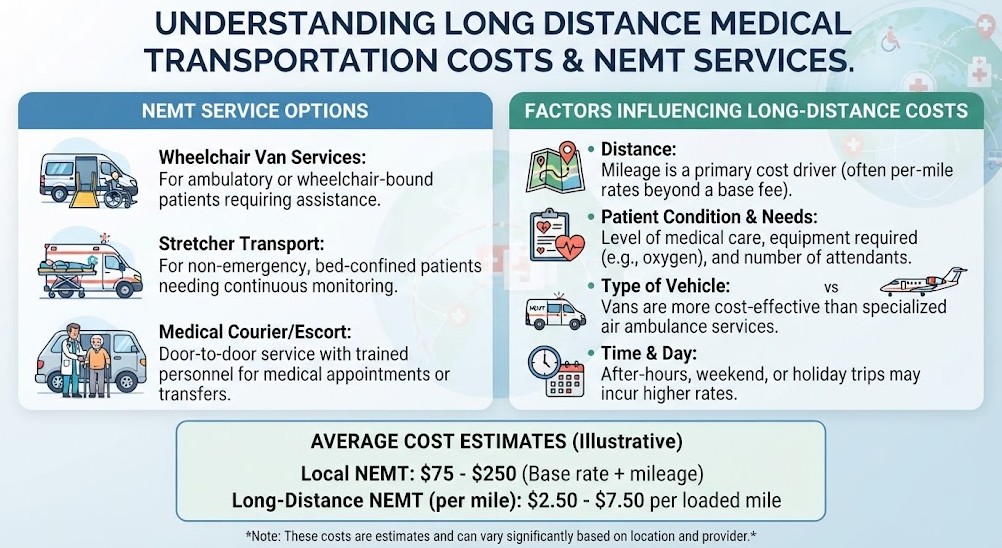
Private non-emergency providers charge more and schedule around the patient. For a treatment running three mornings a week indefinitely, the consistency usually justifies the cost.
Many families combine approaches, using paratransit on the days that allow flexibility and a private provider on the ones that do not.
Setting Up a Standing Arrangement
The single most useful thing a family can do is book the whole rotation as one recurring arrangement rather than scheduling trip by trip.
A standing booking holds the same pickup time on each treatment day for as long as the rotation lasts. The driver learns the route, the center, and the entrance. The patient stops explaining their situation every week. Nobody is making a phone call on Sunday night to arrange Monday morning.
Ask the provider directly how they handle the return leg when a session runs long. The workable answers are a driver who waits on site, a call-back arrangement with a stated response window, or a scheduled return with a buffer built in. A provider who cannot answer this clearly is not set up for dialysis work.
Questions Worth Asking Before the First Week
Confirm the service level against how the patient moves after treatment rather than before it. Ask what happens if the usual vehicle breaks down on a treatment morning, since a missed session is not a minor inconvenience.
Settle the pricing structure in writing, including how wait time is handled. On dialysis runs, wait time is the line item that surprises families most.
Ask about weather and holidays. Florida storm season interrupts schedules, and treatment does not pause for a holiday, so a provider that closes on those days leaves a gap someone has to fill.
Keeping the Rotation Intact
The goal with dialysis transportation is boring reliability. No scrambling, no last-minute calls, no sessions missed because a ride fell through.
That comes from booking the full rotation at once, choosing a service level that fits the patient at their most tired rather than their most capable, and agreeing in advance on what happens when a session runs long. Patients who get those three things settled in the first two weeks tend not to think about transportation again for months, which is exactly the point.